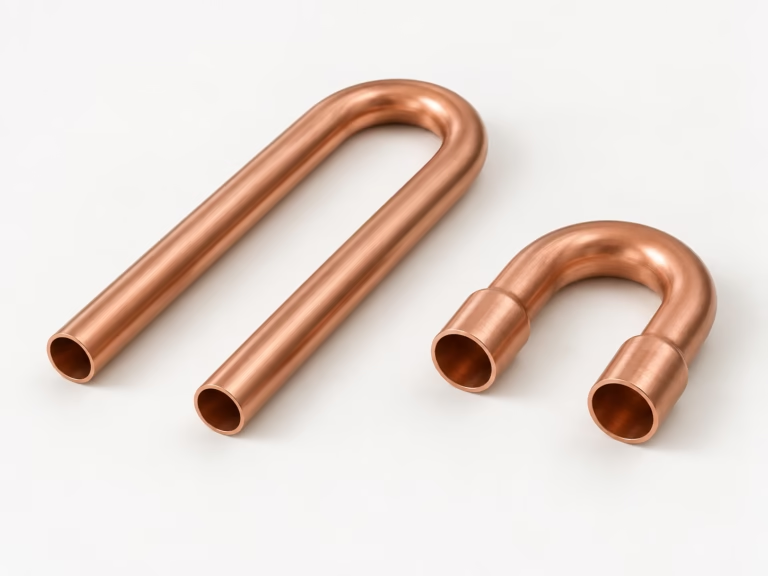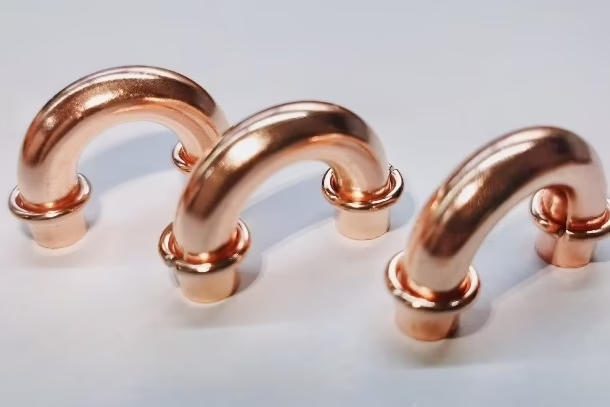
Copper U-bends and return bends are widely used in refrigeration, air conditioning, and heat exchanger manufacturing. Both components redirect fluid flow, usually through a 180-degree turn, and connect different sections of copper tubing.
Although the names are sometimes used differently, a copper return bend is generally a type of U-shaped fitting. In heat exchanger manufacturing, “return bend” commonly describes a compact component connecting two parallel tubes. “U-bend” is a broader term that can also describe longer or specially formed tubing.
For OEM buyers, the product name is less important than the required tube diameter, bend radius, center distance, leg length, and connection details.
This guide explains the terminology, dimensional differences, applications, and selection requirements for copper U-bends and return bends.
Are Copper U-Bends and Return Bends the Same?
In many refrigeration applications, copper U-bends and copper return bends refer to the same basic component: a copper tube formed into a 180-degree bend.
The terminology usually depends on the equipment design and how manufacturers describe their products.
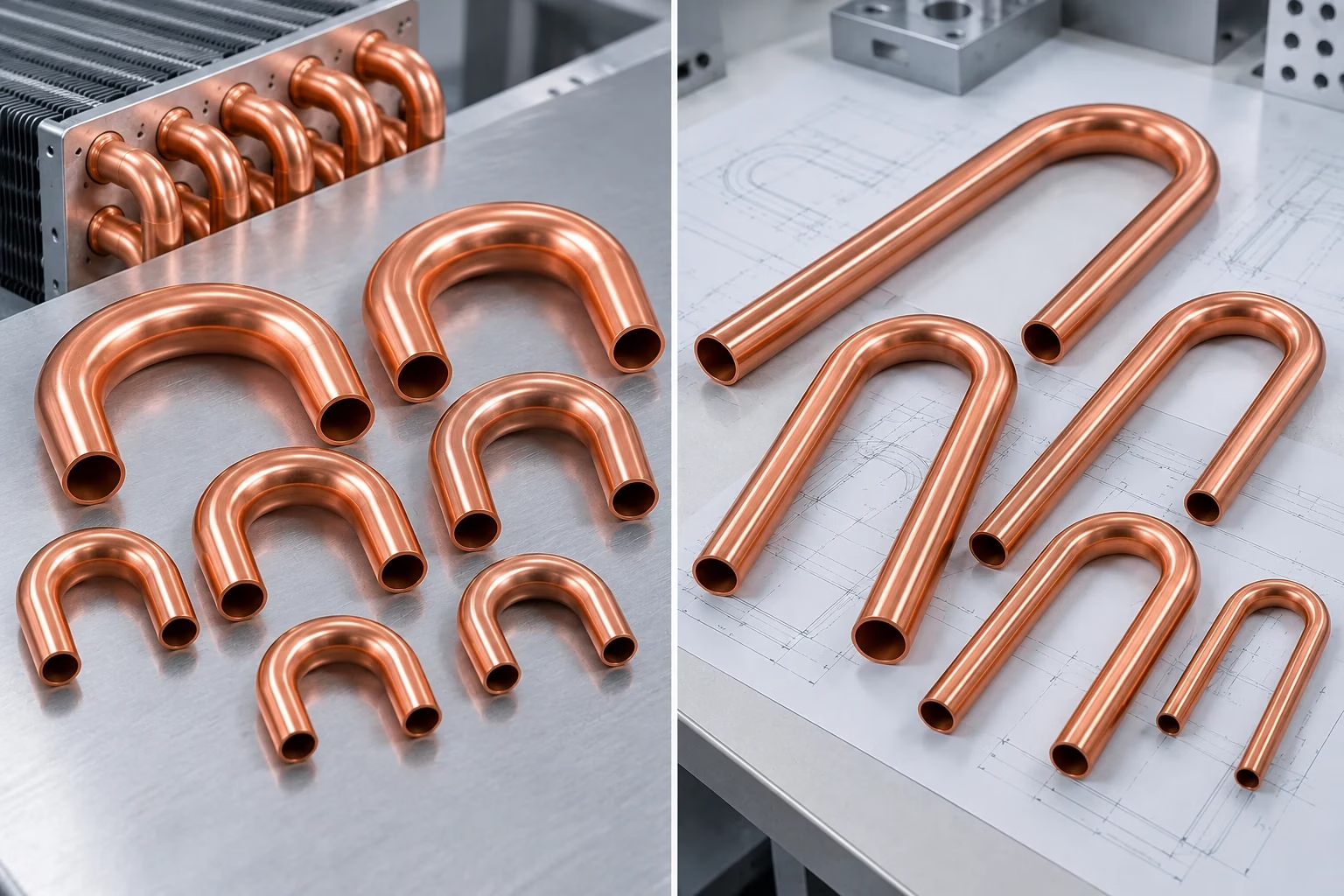
For example, a compact U-shaped fitting connecting adjacent tubes in a condenser is commonly called a return bend. A longer U-shaped tube used to connect more widely spaced components may simply be called a U-bend.
However, there is no universal rule that separates the two names according to bend radius or leg length.
The engineering drawing should always determine the actual product specification.
What Is a Copper U-Bend?
A copper U-bend is a formed tube component that changes fluid direction through approximately 180 degrees. It generally consists of a curved section and two straight or partially formed ends.
Copper U-bends can be produced with different tube diameters, bend radii, and leg lengths to suit the equipment layout.
Common design variations include:
-
Symmetrical U-bends with equal straight legs
-
U-bends with extended straight sections
-
U-bends with expanded or reduced connection ends
-
Custom bends with specific center distances
Copper U-bends are commonly used in refrigeration equipment, heat exchangers, and other fluid-handling assemblies.
Longer U-shaped tubes may be needed when the connection points are separated by a greater distance or when additional clearance is required for installation.
What Is a Copper Return Bend?
A copper return bend is a 180-degree fitting commonly used to connect two parallel tubes in a heat exchanger.

In fin-and-tube evaporators and condensers, multiple return bends are installed at the ends of tube circuits. They allow refrigerant to flow from one tube into another, creating the required circuit path through the heat exchanger.
Return bends are often compact because the distance between adjacent tubes is limited by the heat exchanger design.
The critical requirements typically include tube outside diameter, center-to-center distance, bend profile, and connection-end geometry.
Some return bends are manufactured with expanded ends or other features to suit brazed connections.
Consistent dimensions are especially important when many return bends must fit the same heat exchanger assembly.
Copper U-Bend vs Return Bend: Key Differences
The following table compares how these terms are commonly used in refrigeration manufacturing.
| Comparison | Copper U-Bend | Copper Return Bend |
|---|---|---|
| Basic shape | U-shaped tube, generally 180° | U-shaped fitting, generally 180° |
| Terminology | Broader description | Common heat exchanger term |
| Typical geometry | Compact or extended legs | Often compact |
| Center distance | Defined by assembly design | Usually matches heat exchanger tube pitch |
| Leg length | Can vary considerably | Often determined by joining requirements |
| Connection ends | Plain, expanded or custom formed | Plain, expanded or custom formed |
| Typical application | Refrigeration tubing and custom assemblies | Evaporator and condenser tube connections |
| Customization | Based on drawing requirements | Based on drawing requirements |
These are typical naming conventions rather than fixed technical classifications.
A compact copper U-bend can also be sold as a return bend, provided its dimensions and construction meet the required application.
Common Applications in Refrigeration and Heat Exchangers
Both components are used in HVAC/R equipment, but their geometry is selected according to the tube arrangement and available installation space.
Evaporators and Condensers
Copper return bends are commonly used at the ends of fin-and-tube heat exchanger circuits.
They connect adjacent copper tubes and allow refrigerant to pass through multiple rows or circuits. Their center distance must match the tube spacing, while their connection ends must suit the joining method.
Refrigeration and Heat Pump Assemblies
Copper U-bends can connect sections of tubing where a 180-degree change in direction is required.
Depending on the equipment layout, longer straight sections may provide clearance around adjacent components or simplify assembly.
Tube diameter, bend radius, and connection locations are determined by the refrigeration circuit design.
Custom OEM Tube Components
Both U-bends and return bends can be incorporated into custom copper tube assemblies.
These components may require nonstandard leg lengths, special end forms, or additional bends to fit within compact equipment.
For OEM production, manufacturers normally work from an approved drawing to maintain consistent component dimensions.
Key Dimensions to Check Before Ordering
Whether the component is called a U-bend or return bend, the same essential dimensions must be checked.
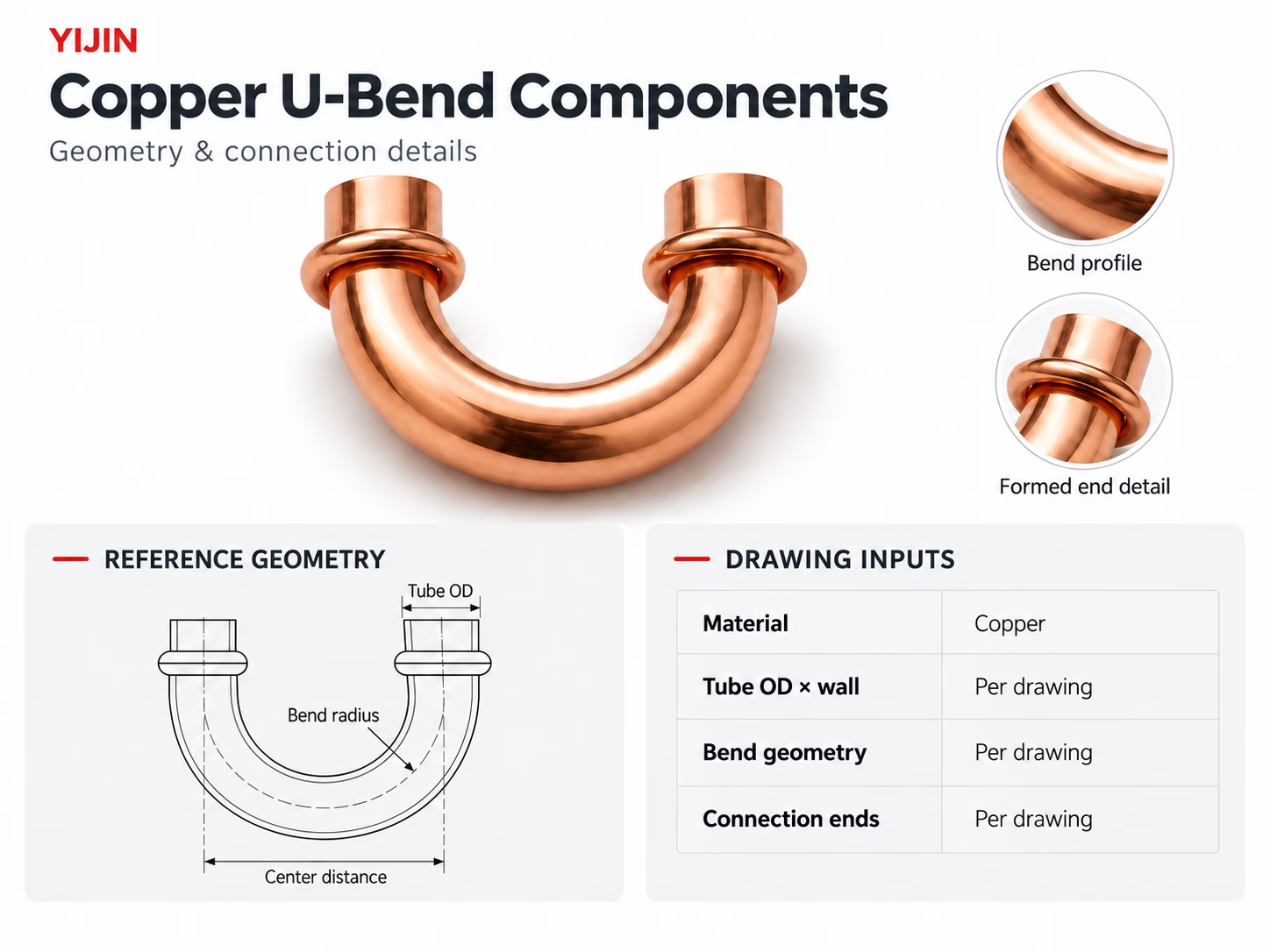
C = center-to-center distance; R = centerline bend radius; OD = outside diameter; WT = wall thickness. Exact geometry depends on the approved drawing.
Tube Outside Diameter (OD): The tube diameter must match the connecting tubes and intended joining interface. Common refrigeration tube diameters include 6.35 mm, 7.94 mm, 9.52 mm, 12.7 mm, and 15.88 mm.
Wall Thickness (WT): Wall thickness affects pressure capability and forming behavior. It should be specified according to the refrigeration system design.
Center-to-Center Distance (C): This is the distance between the centerlines of the two parallel ends. For return bends, it typically matches the heat exchanger tube pitch.
Bend Radius (R): The centerline bend radius controls the curvature of the component. For an ideal semicircular 180-degree bend, the center distance equals twice the bend radius.
Straight Leg Length: The straight ends must provide sufficient space for joining and installation. Equal or unequal leg lengths may be specified.
End Connections: Plain, expanded, reduced, or specially formed ends may be used depending on the mating components.
How to Choose the Right Copper Bend
Start by checking where the component will be installed.
For a fin-and-tube heat exchanger, the tube diameter and center distance are usually the first dimensions to confirm. The return bend must align with the tube ends without excessive force during assembly.
For a custom refrigeration tube assembly, review the overall routing and available clearance. A longer U-bend may be appropriate when the connection points are farther apart.
Next, confirm the required bend radius and straight-end lengths. Tight bends require suitable tube material, wall thickness, and forming processes to control cracking, wrinkling, and flattening.
Finally, check the connection method, operating pressure, refrigerant compatibility, and inspection requirements.
For repeat OEM production, an approved drawing and sample provide a reliable basis for maintaining dimensional consistency.
Custom Copper U-Bends and Return Bends from Yijin
Yijin manufactures copper tube components for refrigeration, HVAC/R, and heat exchanger applications, including Copper U-Bend Components and Copper Return Bends.
Our manufacturing scope includes drawing-based tube bending and end-forming requirements for different component geometries.
We review customer specifications covering tube material, outside diameter, wall thickness, center distance, bend radius, leg length, and connection-end design.
For custom projects, send us your technical drawing, material requirements, estimated quantity, and inspection criteria. Our team can review the component requirements and prepare a quotation.
Frequently Asked Questions
1. Is a copper U-bend the same as a copper return bend?
In many refrigeration applications, yes. Both terms commonly describe a copper tube or fitting that changes fluid direction through approximately 180 degrees. “Return bend” is frequently used for compact heat exchanger connections, while “U-bend” can also describe longer formed tubes. The dimensions and engineering drawing determine whether the components are interchangeable.
2. What are copper return bends used for?
Copper return bends are mainly used in evaporators, condensers, and fin-and-tube heat exchangers. They connect parallel tube sections and allow refrigerant to flow through the required circuit path. The center distance must match the tube spacing, and the connection ends must suit the selected joining process.
3. What dimensions are needed for a custom copper U-bend?
The essential dimensions include tube outside diameter, wall thickness, center-to-center distance, bend radius, and straight-leg lengths. The drawing should also specify copper grade, connection-end geometry, critical tolerances, and inspection requirements. These details allow the manufacturer to assess tooling, forming feasibility, and assembly compatibility before production.
4. Can copper U-bends have different leg lengths?
Yes. Copper U-bends can be manufactured with equal or unequal straight legs according to the equipment layout. Different leg lengths may be required to clear surrounding components or connect tubes at specific locations. The drawing should identify both lengths separately and define how each dimension is measured.
5. Which copper bend is better for a heat exchanger?
For connecting adjacent parallel tubes in a fin-and-tube heat exchanger, a compact return bend is commonly used. However, a longer U-bend may also be suitable if required by the circuit design. The correct selection depends on tube pitch, available clearance, joining requirements, and approved operating conditions.
6. Can Yijin manufacture custom copper U-bends and return bends?
Yes. Yijin manufactures copper U-bends and return bends according to customer drawings for refrigeration and HVAC/R applications. Customers can specify tube diameter, wall thickness, bend geometry, leg lengths, and connection-end features. We review these requirements together with the planned quantity and inspection criteria before confirming a quotation.