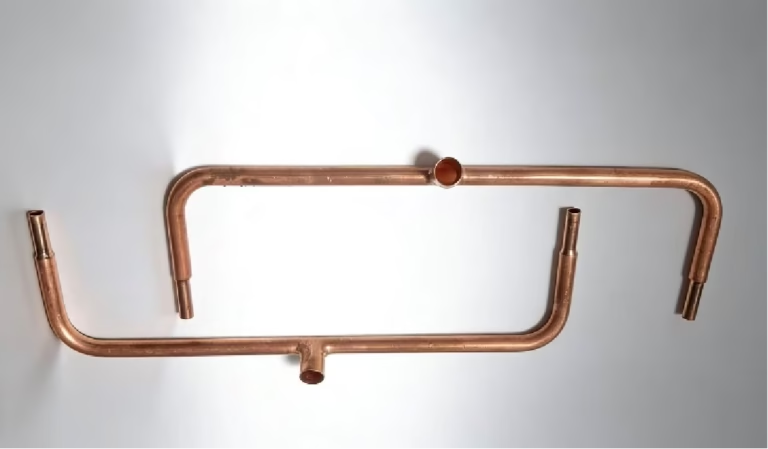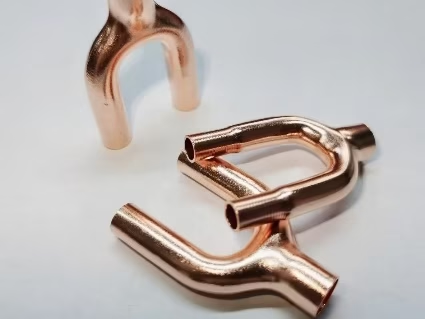
Custom copper tube assemblies are manufactured to fit the specific piping layout, connection points, and installation space of refrigeration, HVAC, and heat exchange equipment. Unlike standard fittings, these components may combine several bends, formed ends, tees, and branch connections into a single assembly.
Manufacturing begins with an approved engineering drawing and continues through material preparation, tube forming, joining, and inspection.
The most important factors in custom copper tube assembly manufacturing are tube geometry, material condition, connection design, dimensional tolerances, and quality control. These requirements must be considered together to achieve consistent assembly fit and reliable operation.
This guide explains the manufacturing process and the technical information OEM buyers should prepare before placing an order.
What Are Custom Copper Tube Assemblies?
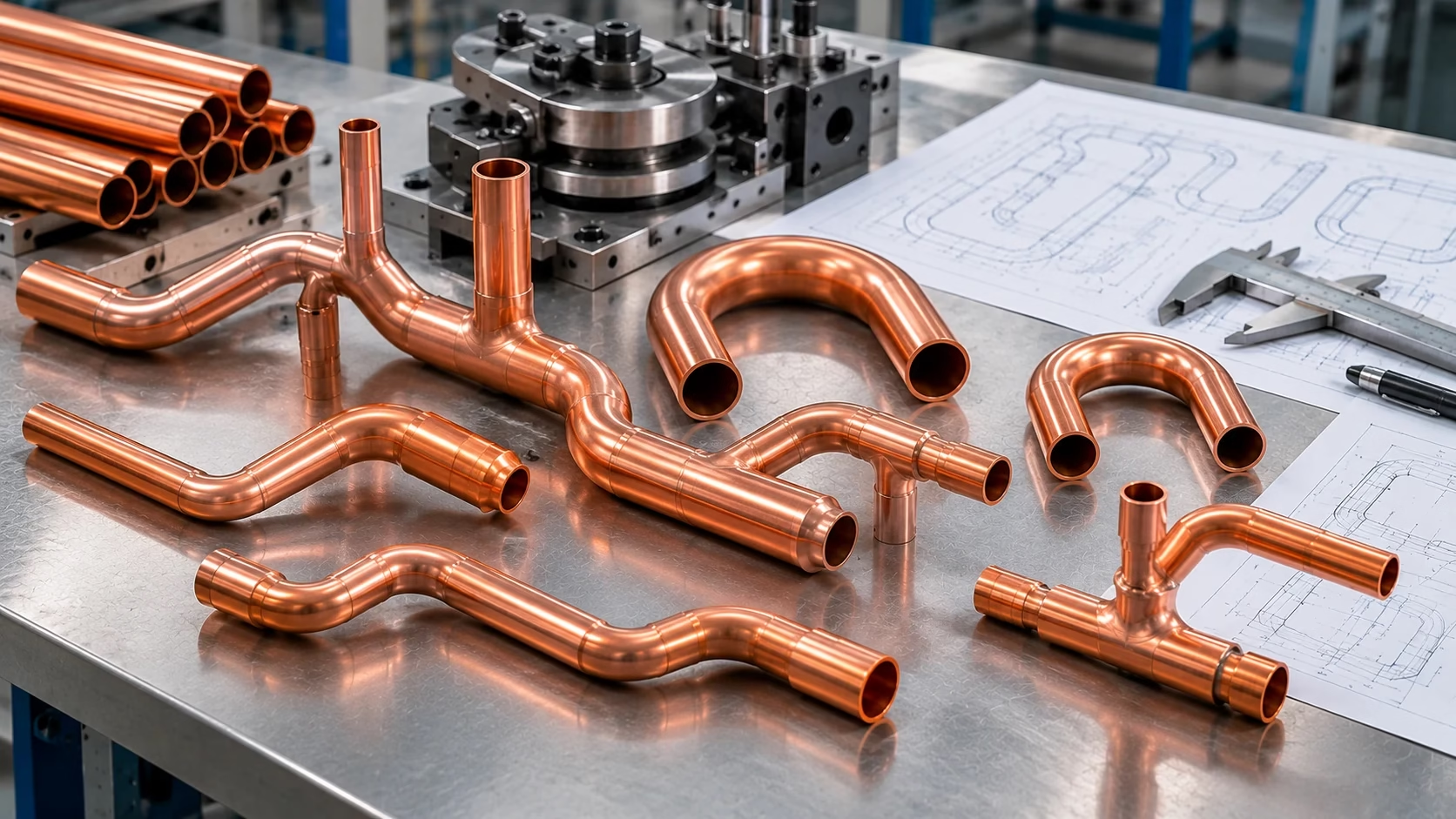
A custom copper tube assembly is a tubing component manufactured according to a specific equipment design rather than a standard catalog size.
It may consist of a single tube with multiple bends or several copper parts joined together.
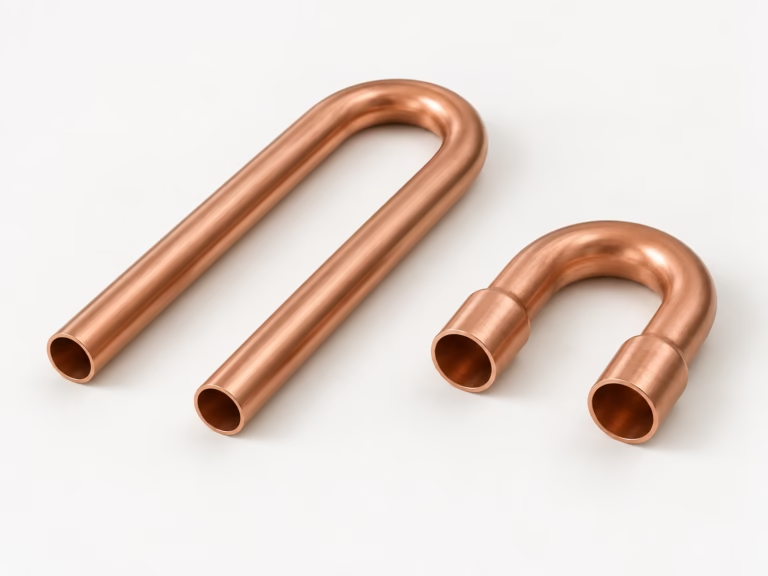
Typical features include 90-degree bends, U-bends, expanded ends, reduced ends, and branch connections.
These components are used where standard straight tubing and fittings cannot provide the required layout or installation clearance.
In refrigeration equipment, custom tube assemblies help connect compressors, heat exchangers, valves, and other circuit components according to the approved piping design.
The finished assembly must maintain suitable flow passages, connection integrity, and dimensional accuracy.
Custom Copper Tube Assembly Manufacturing Process
Manufacturing requirements vary by component, but most OEM projects follow a similar sequence.

- Drawing review
- Material selection
- Tube forming
- Joining
- Inspection
Drawing Review and Material Selection
Production starts with a review of the customer's 2D drawing, 3D model, or approved sample.
The drawing should define the complete tube route, outside diameter, wall thickness, bend radii, connection locations, and critical dimensions.
Material selection depends on the operating conditions and manufacturing requirements.
Phosphorus-deoxidized copper, including C12200, is commonly used in refrigeration tubing. ASTM B280 covers specified seamless copper tubes for air conditioning and refrigeration field service; its scope should be checked before applying it to a custom OEM component.
The copper grade and temper must support both the required forming operations and the intended service conditions.
Tube Cutting, Bending and End Forming
Copper tubes are cut to the required lengths before further processing.
Depending on the design, cutting may be followed by deburring, cleaning, bending, and end forming.
Tube bending creates the required routing geometry. Rotary draw bending is commonly used where repeatable bend angles and radii are needed.
For tighter bends or thin-wall tubing, internal support may be necessary to control flattening and wrinkling.
End forming operations can include expansion, reduction, flaring, or other geometry required for connection to mating components.
The finished ends must provide suitable dimensions and clearance for the specified joining process.
Branch Connections and Brazing
Some assemblies require tee connections or branch outlets to connect multiple tube paths.
Branches may be made using separate fittings or suitable mechanically formed outlets.
Brazing is commonly used for permanent copper tube connections in refrigeration equipment. The Copper Development Association identifies brazing as a preferred joining method for many air conditioning and refrigeration piping applications.
Joint preparation, filler material, heating conditions, and clearance must follow the approved joining procedure.
Where required, an inert gas purge helps limit internal oxidation during brazing.
Branch geometry and joining accessibility should be reviewed during design to avoid manufacturing difficulties.
Inspection and Testing
Completed copper tube assemblies must be checked against the approved specifications.
Typical inspection items include tube dimensions, bend angles, connection positions, surface condition, and joint quality.
For refrigeration applications, internal cleanliness is also important. Residual particles or moisture can affect subsequent system assembly and operation.
Pressure or leak testing may be specified according to the component design and its intended service.
Inspection requirements should be agreed before production rather than introduced after the first batch is completed.
Key Design Requirements for Copper Tube Assemblies
A manufacturable tube assembly requires more than a drawing of the final shape.
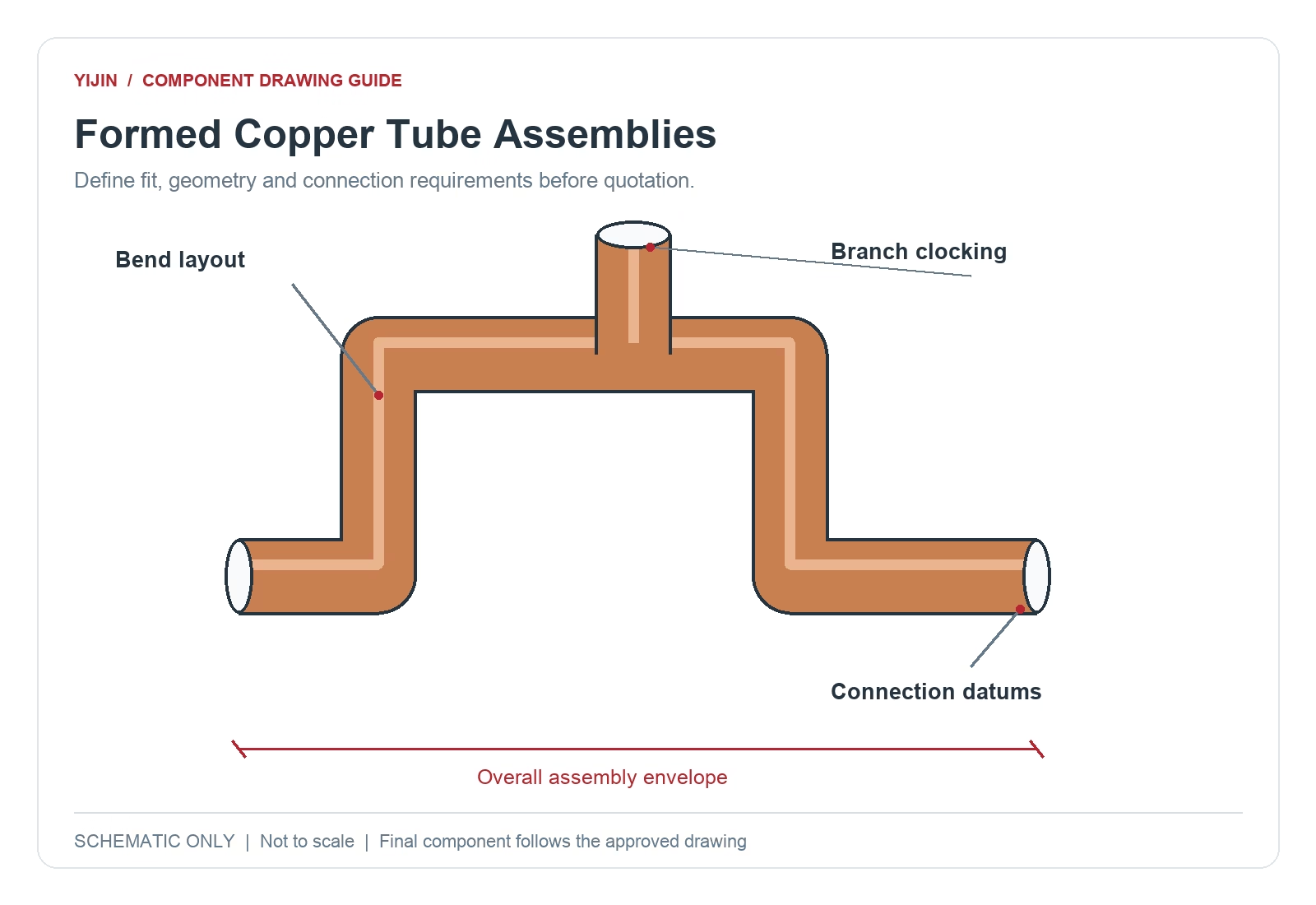
The following design information helps engineers and manufacturers evaluate production feasibility.
| Design Requirement | Why It Matters |
|---|---|
| Copper Grade and Temper | Determines material properties and formability |
| Tube OD and Wall Thickness | Affects connection fit and pressure capability |
| Bend Radius and Angle | Controls geometry and forming difficulty |
| Straight Lengths | Provides space for bending, clamping, and joining |
| Branch Location | Determines fit with mating components |
| Connection-End Geometry | Supports correct joining and assembly |
| Critical Tolerances | Controls repeatability and installation fit |
| Cleanliness and Test Requirements | Defines component acceptance criteria |
For complex multi-bend parts, datum references are especially important.
Dimensions should be measured from clearly defined reference points so the manufacturer and customer inspect the component consistently.
Avoid applying unnecessarily tight tolerances to every feature. Identify the dimensions that directly affect fit or function.
Common Manufacturing Problems and How to Avoid Them
Custom copper tube assemblies can develop manufacturing problems when the geometry and process requirements are not aligned.
| Problem | Common Cause | Recommended Action |
|---|---|---|
| Bend flattening | Tight radius or insufficient support | Review bend radius and tooling |
| Wrinkling | Excessive compression during bending | Improve forming support |
| End misalignment | Accumulated bending variation | Define datums and inspection fixtures |
| Poor joint fit | Incorrect connection dimensions | Review mating ends and clearance |
| Internal oxidation | Inadequate brazing controls | Use suitable purge and joining procedures |
| Leakage | Joint defects or material damage | Apply specified integrity testing |
For assemblies with several bends, dimensional variation can accumulate along the tube route.
Checking only the individual bends may not be sufficient. Critical connection points should also be measured in their final assembled positions.
An approved first article or reference sample can help confirm the manufacturing process before repeat production.
Applications in Refrigeration and HVAC Systems
Custom copper tube assemblies are used in equipment where tubing must follow a specific route and connect multiple components.
Refrigeration Equipment
Formed copper tubing can connect compressors, valves, condensers, and evaporators within a refrigeration circuit.
The component geometry is determined by equipment layout, operating conditions, and available installation space.
Heat Pump and Air Conditioning Units
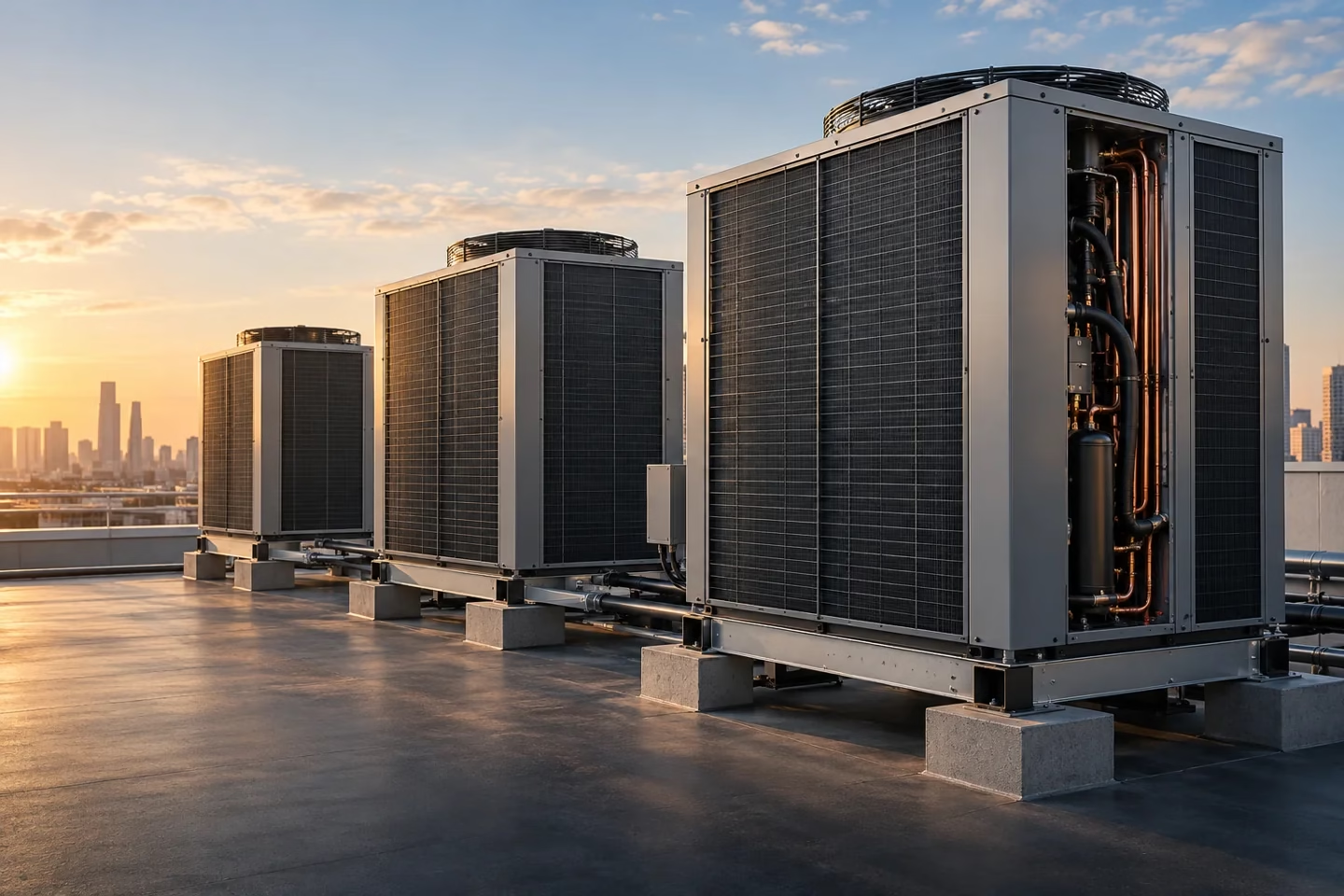
Copper tube assemblies may include multiple bends and connection ends to fit compact outdoor or indoor equipment.
Good dimensional consistency helps reduce assembly adjustments and interference with nearby components.
Heat Exchanger and OEM Equipment
Custom components may incorporate U-bends, return bends, and branch connections as part of a complete heat exchanger or other fluid-handling system.
Their material, joining, and inspection requirements must follow the approved equipment design.
What to Include in an OEM RFQ
A complete request for quotation allows the manufacturer to review the component without repeated technical clarification.
Provide the latest engineering drawing, preferably with a revision number and 3D model for complex geometry.
Specify the copper grade, temper, tube diameter, wall thickness, bend details, and connection ends.
The RFQ should also identify critical tolerances, joining requirements, internal cleanliness, and required inspection or test procedures.
Finally, include the estimated annual quantity, initial order quantity, sample approval requirements, and delivery destination.
For repeat orders, drawing revision control is important. Changes to tube routing, mating interfaces, or inspection criteria should be reviewed before manufacturing.
Custom Copper Tube Assembly Manufacturing at Yijin
Yijin manufactures formed copper tube components for refrigeration and HVAC/R equipment according to customer drawings.
Our Formed Copper Tube Assemblies can incorporate different tube routes, bend geometries, connection ends, and branch features as specified for the project.
We review customer requirements for material selection, dimensions, forming geometry, and inspection before confirming the manufacturing specification.
For OEM sourcing, send us your drawing, technical requirements, expected quantities, and any reference samples. Our team can review the component and prepare a quotation based on the approved design.
Frequently Asked Questions
1. What are custom copper tube assemblies used for?
Custom copper tube assemblies are used in refrigeration, HVAC, heat exchangers, and industrial fluid-handling equipment. They connect components through specified tube routes that may include multiple bends, formed ends, and branch connections. Their geometry is designed around equipment layout, installation clearance, operating requirements, and the intended joining method.
2. What processes are used to manufacture copper tube assemblies?
Typical processes include material preparation, tube cutting, bending, end forming, branch fabrication, joining, cleaning, and inspection. The exact sequence depends on the component geometry and production requirements. Some assemblies consist of a single bent tube, while others require several formed components to be joined together.
3. What copper materials are commonly used for refrigeration tubing?
Phosphorus-deoxidized copper, including C12200, is commonly used for refrigeration tubing because of its manufacturing and joining characteristics. Other specified copper grades may be suitable depending on the application. Material selection should consider the operating conditions, tube dimensions, forming process, and applicable equipment requirements.
4. How are custom copper tube assemblies tested?
Inspection may include dimensional measurement, visual examination, connection checks, and internal cleanliness verification. Pressure or leak testing can also be specified for pressure-containing assemblies. Test methods, acceptance limits, and documentation should be defined in the customer's approved drawing or purchase specification before production.
5. What information should I provide for a copper tube assembly quotation?
Provide a dimensioned drawing or 3D model, copper material specification, tube sizes, bend geometry, connection ends, critical tolerances, and inspection requirements. Include estimated production quantities and sample approval needs. If the component must fit existing equipment, a mating assembly drawing or approved reference sample can help confirm compatibility.
6. Can Yijin manufacture custom copper tube assemblies for OEM projects?
Yes. Yijin manufactures drawing-based copper tube assemblies for refrigeration and HVAC/R applications. Customers can specify material, tube route, bends, branches, connection ends, dimensional tolerances, and inspection requirements. Our team reviews the technical documentation and order quantities before confirming manufacturing feasibility and quotation.