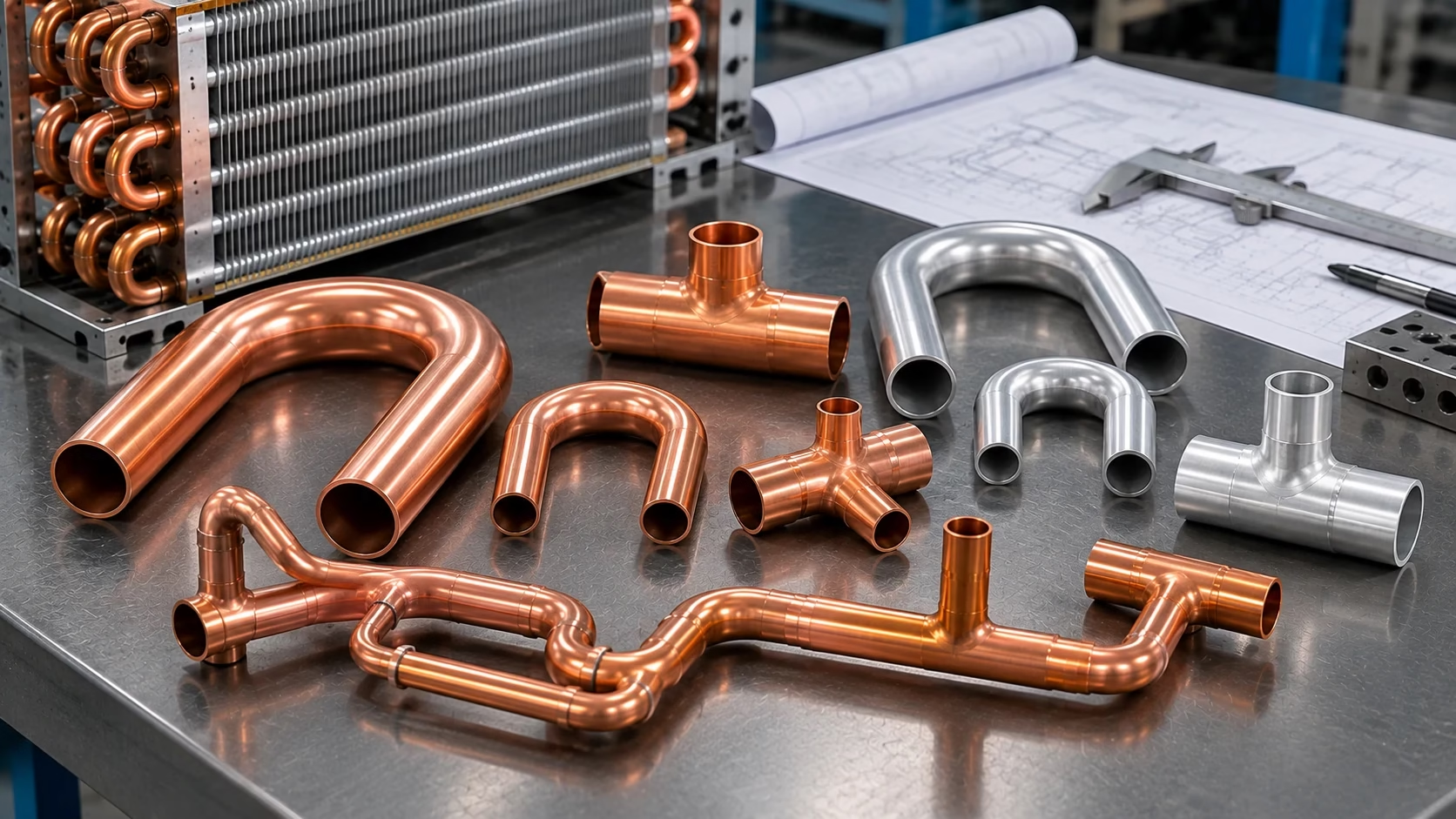
Refrigeration tube fittings connect, redirect, or branch refrigerant tubing in air conditioning, heat pumps, condensers, evaporators, and other HVAC/R equipment. The correct fitting must match the tubing layout while meeting the system's material, pressure, temperature, and joining requirements.
Common components include copper and aluminum U-bends, return bends, tee fittings, branch connections, and custom formed tube assemblies.
Choosing the right refrigeration tube fitting starts with four factors: connection function, tube material, dimensional compatibility, and operating conditions. A fitting that matches the tube diameter may still be unsuitable if its geometry, joining method, or pressure capability does not meet the equipment design.
This guide explains how to compare common fitting types and prepare specifications for OEM procurement.
What Are Refrigeration Tube Fittings?
Refrigeration tube fittings are components used to connect tubing sections and establish the required refrigerant flow path.
They perform three main functions: changing flow direction, creating branch connections, and joining tubing components within an assembly.
For example, a return bend connects adjacent tubes in a heat exchanger, while a tee fitting provides a connection between a main line and a branch.
Some fittings are separate components installed during equipment assembly. Others are integrated into preformed tubing assemblies to reduce the number of individual parts.
Refrigeration fittings must also be distinguished from general plumbing fittings. Refrigerant pressure, temperature, cleanliness, material compatibility, and joining requirements may differ considerably.
The fitting must therefore be approved for the intended refrigeration application rather than selected by appearance or nominal size alone.
Types of Refrigeration Tube Fittings
Different fitting types perform different functions in HVAC/R equipment.
| Fitting Type | Main Function | Typical Application |
|---|---|---|
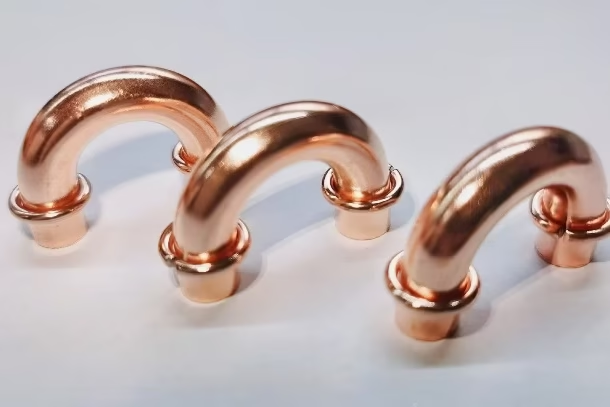
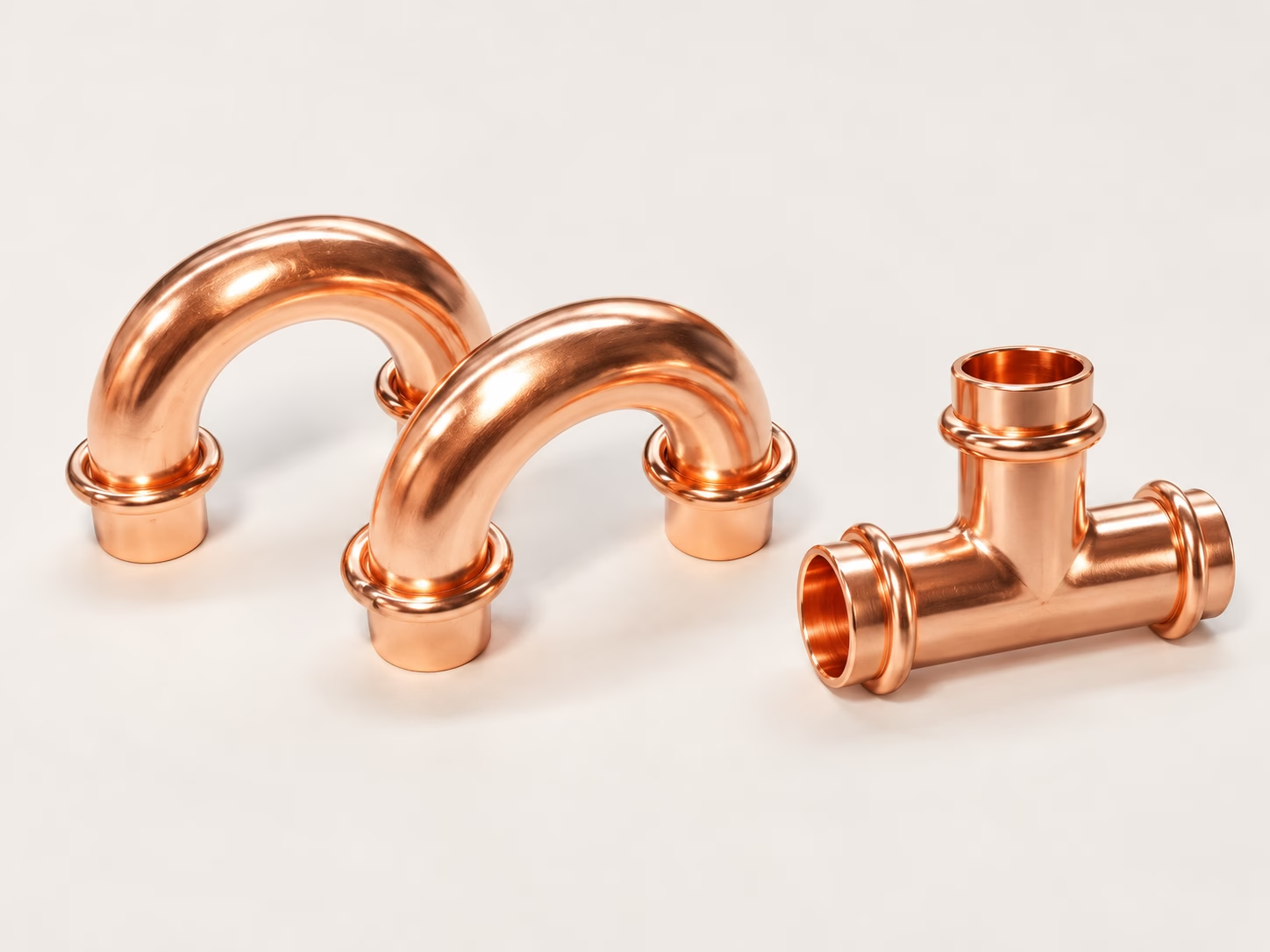
| Copper U-Bends | Redirect tubing through approximately 180° | Refrigeration tube routing |
| Copper Return Bends | Connect adjacent parallel tubes | Evaporators and condensers |
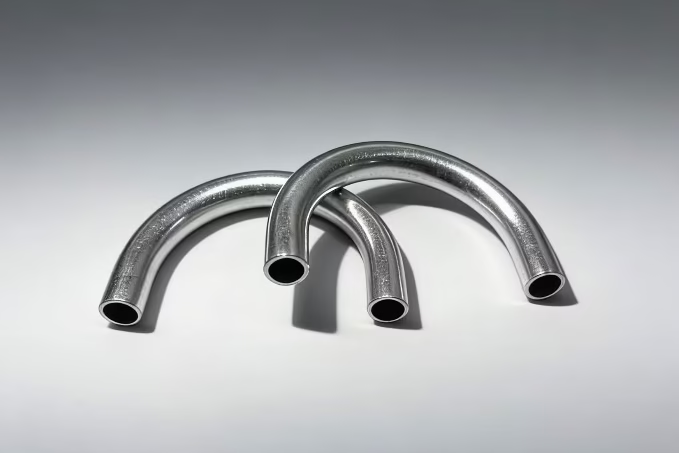
| Aluminum U-Bends | Provide lightweight curved connections | Compatible aluminum tubing assemblies |
| Aluminum Return Bends | Connect parallel aluminum tube circuits | Aluminum heat exchanger designs |
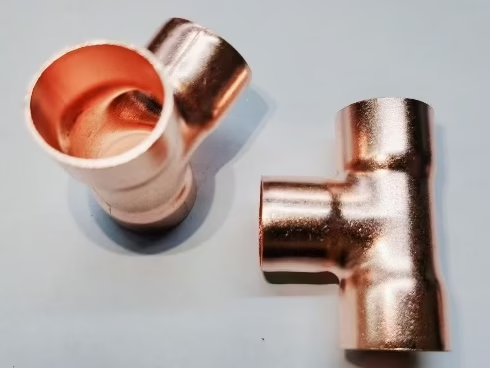
| Copper Tee Fittings | Connect three tube sections | Refrigerant piping branches |
| Copper Branch Fittings | Provide customized junction geometry | Compact OEM assemblies |
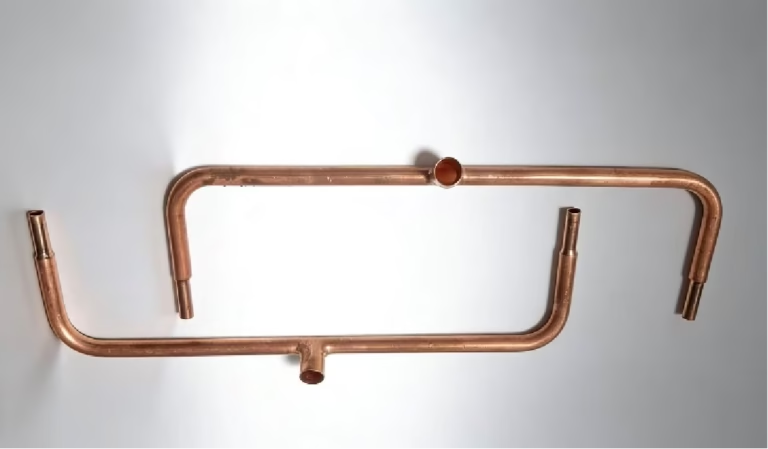
| Formed Copper Tube Assemblies | Combine multiple bends and connections | Equipment-specific refrigeration circuits |
U-Bends and Return Bends
U-bends and return bends are commonly used where tubing must change direction by approximately 180 degrees.
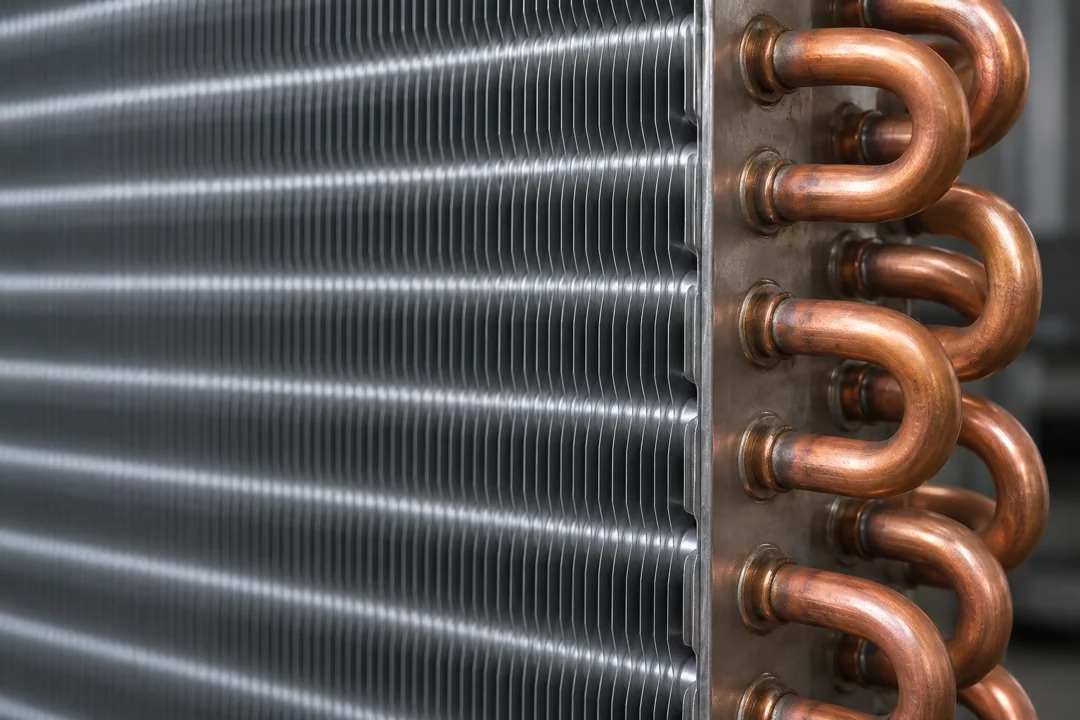
In fin-and-tube heat exchangers, compact return bends connect parallel tube ends. Their center-to-center distance must match the tube spacing.
Longer U-bends may be used in other tubing arrangements where additional straight length or installation clearance is required.
The two terms often overlap. The drawing should define the required geometry rather than relying on the product name alone.
Tee and Branch Fittings
Tee fittings provide three connection ports, commonly with a 90-degree branch.
Equal tees use matching nominal connection sizes, while reducing tees accommodate different tube diameters.
Custom branch fittings may have angled outlets, different branch positions, or specially formed connections.
These fittings establish a junction but do not automatically provide controlled refrigerant distribution. Applications requiring precise flow distribution may need a dedicated distributor.
Custom Formed Tube Assemblies
Custom tube assemblies combine bending, end forming, and connection features into a component designed for a particular equipment layout.
They are useful where standard fittings cannot match the available space or required connection positions.
The drawing defines the tube route, material, joining interfaces, and inspection requirements.
Copper vs Aluminum Refrigeration Fittings
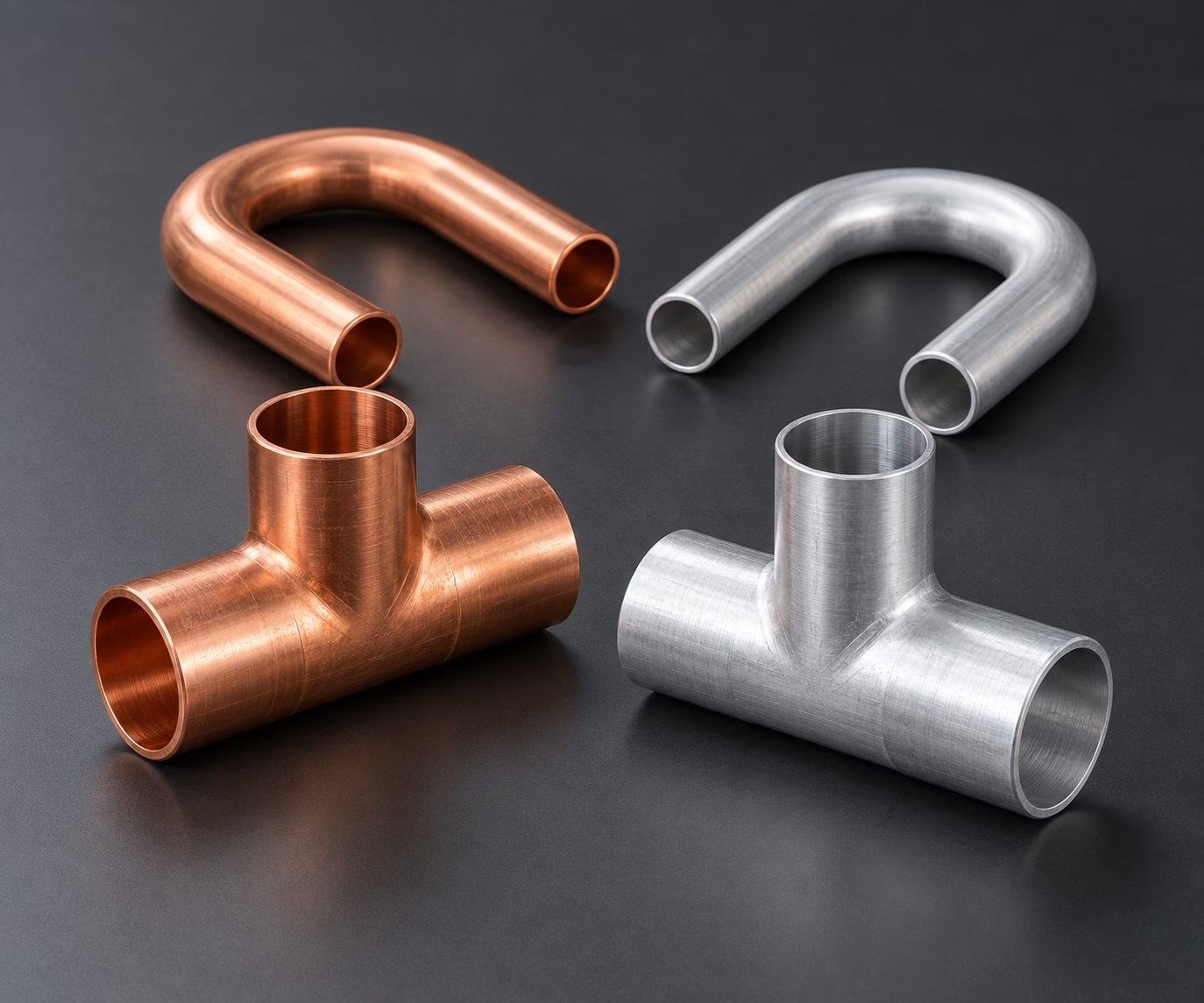
Copper and aluminum are both used in refrigeration equipment, but their manufacturing and service characteristics differ.
| Selection Factor | Copper | Aluminum |
|---|---|---|
| Weight | Higher density | Lightweight |
| Thermal conductivity | Higher | Lower than copper |
| Formability | Excellent in suitable tempers | Alloy- and temper-dependent |
| Joining | Established refrigeration brazing methods | Requires compatible joining processes |
| Material cost | Generally higher | Generally lower |
| Applications | Refrigerant lines, fittings, formed assemblies | Aluminum coils and compatible tube assemblies |
Copper is frequently selected for refrigeration piping because of its established joining methods and good formability.
Aluminum is often used in equipment where reducing weight and material cost is important.
However, replacing copper with aluminum is not a direct one-for-one decision. The change may affect tube dimensions, joining equipment, corrosion protection, and system qualification.
Copper-to-aluminum transitions also require attention to galvanic corrosion and connection integrity.
For an existing equipment design, use the approved material unless the proposed alternative has been reviewed and validated.
Key Specifications to Check Before Selection
Tube fittings must match both the connection dimensions and operating requirements of the equipment.
- Define the fitting function.
- Select the material.
- Confirm geometry and dimensions.
- Specify the joining process.
- Set inspection requirements.
Tube Outside Diameter and Wall Thickness
Confirm the actual tube outside diameter rather than relying only on a nominal size designation.
Wall thickness must meet the system's pressure and manufacturing requirements.
Bend Geometry and Connection Positions
For U-bends and return bends, check the center distance, bend radius, straight lengths, and overall envelope.
For tees and branch fittings, confirm the run dimensions, branch size, angle, and position.
Material and Operating Conditions
Specify the material grade, temper where relevant, refrigerant, design pressure, operating temperature, and environmental conditions.
Connection and Inspection Requirements
Identify whether the part requires brazing, mechanical connections, expanded ends, or another approved joining method.
Dimensional tolerances, internal cleanliness, pressure testing, and leak testing should be defined where applicable.
ASHRAE's guidance on pipe and tube design identifies the importance of correct copper tube sizing and material specifications for refrigeration service.
How to Select Fittings for Different HVAC Applications
The installation location and equipment function determine the most suitable fitting geometry.
Evaporators and Condensers
Fin-and-tube heat exchangers commonly use compact return bends to connect adjacent tube paths.
The key dimensions are tube outside diameter, center distance, bend profile, and mating-end geometry.
Copper or aluminum return bends are selected according to the approved heat exchanger material and construction.
Air Conditioning and Heat Pump Systems
Air conditioning and heat pump equipment may require curved tube connections, tees, or formed tubing assemblies around compressors, valves, and heat exchangers.
Space constraints often influence bend radii, straight lengths, and branch positions.
Component geometry should allow sufficient clearance for assembly, joining, and inspection.
Custom OEM Refrigeration Equipment
For equipment with nonstandard layouts, drawing-based fittings may be more suitable than catalog components.
Custom formed assemblies can combine multiple bends, branches, and connection ends.
The design should account for manufacturing sequence, dimensional variation, component accessibility, and the required inspection process.
Common Fitting Selection Mistakes
Several common errors can cause assembly delays, additional costs, or component rejection.
| Common Mistake | Potential Problem | Recommended Action |
|---|---|---|
| Selecting by nominal size alone | Connection mismatch | Confirm actual OD and end geometry |
| Ignoring wall thickness | Unsuitable pressure capability | Review system requirements |
| Incorrect bend radius | Assembly interference or deformation | Verify drawing geometry |
| Using an unsuitable joining method | Weak or leaking connections | Specify an approved process |
| Replacing copper with aluminum without review | Joining and compatibility risks | Validate material substitution |
| Missing critical tolerances | Inconsistent installation fit | Define functional dimensions |
| Omitting cleanliness requirements | Refrigeration circuit contamination | Specify cleaning and protection |
For repeat OEM orders, an approved sample and controlled drawing revision can reduce manufacturing and assembly problems.
What to Include in an OEM Fittings RFQ
A complete request for quotation helps the manufacturer identify the required fitting and review production feasibility.
Provide a 2D technical drawing or 3D model showing the component geometry and connection positions.
Include the material grade, tube outside diameter, wall thickness, bend radii, center distances, and connection-end details.
The RFQ should also state the refrigerant, applicable operating conditions, critical tolerances, and inspection requirements.
For custom components, provide estimated annual demand, initial order quantity, sample approval requirements, and packaging needs.
If the fitting must connect to existing equipment, a mating tube drawing can help confirm assembly compatibility.
Custom Refrigeration Tube Fittings from Yijin
Yijin manufactures copper and aluminum tube components for refrigeration and HVAC/R equipment.
Our product range includes copper U-bends, return bends, tee fittings, branch fittings, aluminum U-bends, aluminum tee fittings, and formed copper tube assemblies.
We manufacture components according to customer drawings, with technical review covering material requirements, tube dimensions, bend geometry, connection ends, and inspection criteria.
Customers can review our Copper & Aluminum Refrigeration Fittings product range to identify suitable component types.
For custom OEM projects, send us your engineering drawing, material specifications, estimated order quantity, and required inspection details. Our team can review the design and prepare a quotation.
Frequently Asked Questions
1. What fittings are commonly used in refrigeration systems?
Common refrigeration fittings include elbows, U-bends, return bends, tees, branch fittings, couplings, and custom formed tubing components. Each performs a different connection or routing function. The fitting must match the tube diameter, material, pressure requirements, joining method, and intended refrigerant circuit rather than being selected only by its general shape.
2. Are copper fittings better than aluminum fittings for HVAC systems?
Copper fittings offer established refrigeration joining methods and good formability. Aluminum fittings provide lower weight and can reduce material costs in compatible equipment designs. Neither material is automatically better for every application. The correct choice depends on the refrigerant, operating conditions, tube geometry, corrosion environment, and approved manufacturing process.
3. What is the difference between a refrigeration U-bend and a return bend?
Both are generally U-shaped components that redirect flow through approximately 180 degrees. Return bend is commonly used for compact connections between adjacent heat exchanger tubes, while U-bend is a broader term that can include longer straight sections. These names frequently overlap, so the drawing must specify the actual dimensions and connection requirements.
4. How do I choose the correct refrigeration fitting size?
Start with the actual outside diameter and wall thickness of the connecting tubes. Then confirm the fitting geometry, mating-end dimensions, and installation clearance. For bends, check the radius and center distance. For tees or branches, specify all connection sizes and branch positions. Operating conditions and joining requirements must also be satisfied.
5. Can copper and aluminum refrigeration fittings be connected?
Yes, suitable copper-to-aluminum transitions can be made using qualified connection designs and joining methods. However, dissimilar metal contact can create galvanic corrosion risks in the presence of moisture. The transition must also meet the refrigeration system's pressure, temperature, refrigerant compatibility, and joint-integrity requirements before being approved for use.
6. Can Yijin manufacture custom refrigeration tube fittings?
Yes. Yijin manufactures drawing-based copper and aluminum fittings for refrigeration and HVAC/R applications, including return bends, U-bends, tees, branches, and formed copper tube assemblies. Customers can provide material specifications, tube dimensions, connection geometry, critical tolerances, inspection requirements, and order quantities for manufacturing review and quotation.