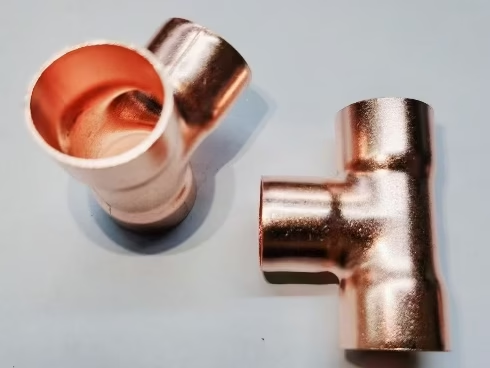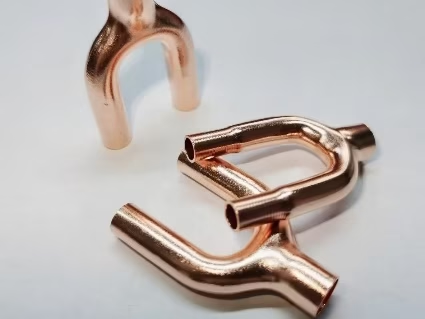
Copper tee fittings are used in refrigeration and HVAC systems to connect three sections of tubing at a single junction. They are commonly installed in refrigerant piping, heat pump assemblies, and custom copper tube circuits where a branch connection is required.
The main types include equal copper tees, reducing copper tees, and custom formed tee fittings. Each serves a different piping arrangement.
The correct copper tee fitting depends on tube diameter, branch size, connection type, operating pressure, and the intended refrigerant circuit. A fitting that matches the tube size must also meet the joining and service requirements of the system.
This guide explains copper tee types, dimensions, material requirements, and practical selection considerations for refrigeration engineers and OEM buyers.

What Are Copper Tee Fittings for Refrigeration?
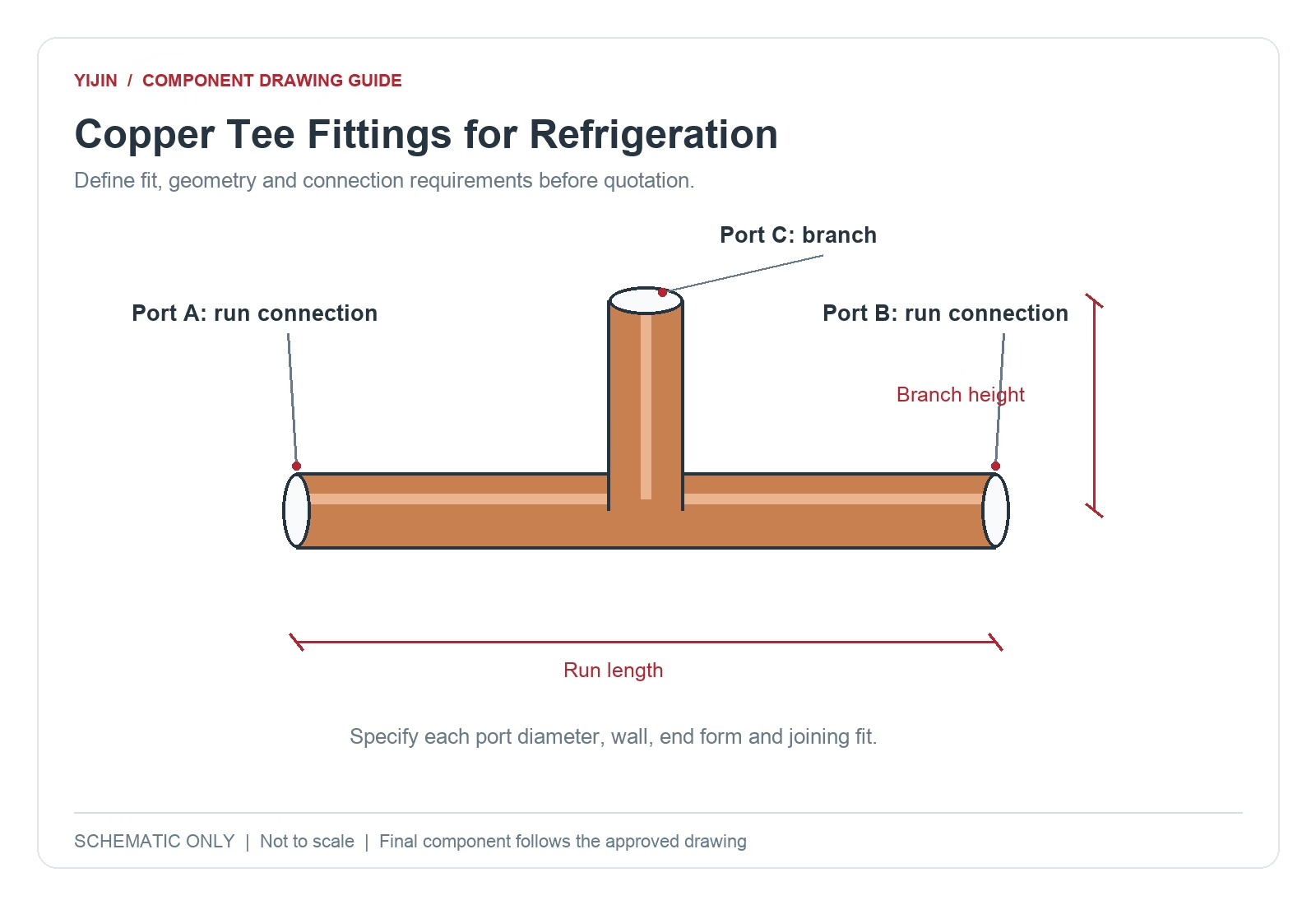
A copper tee is a three-port fitting consisting of a straight main passage, called the run, and a branch connection.
The branch is commonly positioned at 90 degrees to the run, forming a T-shaped junction.
Depending on the circuit design, a tee may divide flow from one line into two paths or combine flows into a common line.
In refrigeration systems, copper tees can be used to connect compatible pipe sections, establish branch circuits, or provide connections within custom tube assemblies.
However, a tee is not automatically a refrigerant distribution device. Where precise refrigerant distribution is required, such as feeding multiple evaporator circuits after an expansion device, a purpose-designed distributor may be necessary.
Copper tees are commonly manufactured from suitable copper tubing or wrought copper fittings, with connection ends designed for brazing or other approved joining methods.
Types of Copper Tee Fittings
Copper tee fittings are generally classified according to the relationship between their three connection sizes and their manufacturing geometry.
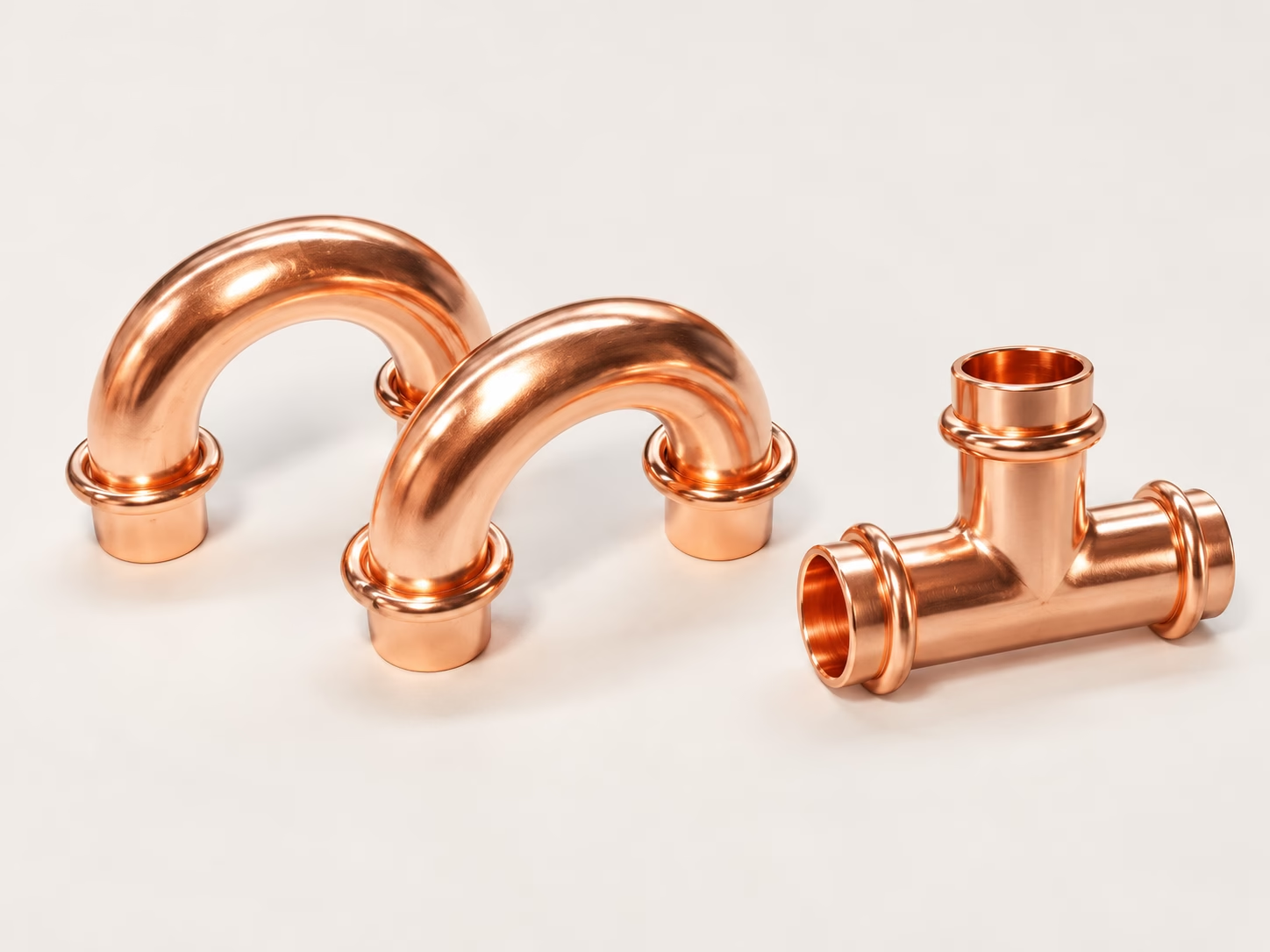
Equal Copper Tees
An equal copper tee has three connection ports of the same nominal size.
For example, a tee specified as 3/8 × 3/8 × 3/8 inch has three nominally equal connections, although the actual fitting-end dimensions depend on the connection type.
Equal tees are commonly used when the branch circuit and main line require matching connection sizes.
They provide a straightforward junction for tube assemblies without requiring a change in nominal tube diameter.
Reducing Copper Tees
A reducing copper tee has at least one connection size different from the others.
For example, a tee may have two 1/2-inch nominal run connections and a 3/8-inch branch connection.
Reducing tees are useful where the branch line uses a smaller tube diameter than the main line.
The size difference must be selected according to the refrigerant flow requirements and pressure-drop considerations. Using a reducing tee does not automatically provide the correct flow balance between connected circuits.
Custom Formed Copper Tees
Custom formed copper tees are manufactured according to specific engineering drawings rather than a standard catalog configuration.
They may have different run lengths, branch positions, connection-end geometries, or mating tube dimensions.
These components are often used in compact refrigeration equipment where standard fittings do not match the available installation space.
For OEM production, the drawing should define the main run, branch connection, end preparation, and dimensional tolerances.
Copper Tee Fitting Sizes and Connection Dimensions
Copper tee fittings are available in different nominal and actual connection sizes. Refrigeration systems commonly use inch-based copper tubing dimensions.
The following table gives examples of actual tube outside diameters frequently encountered in refrigeration applications.
| Tube OD | Metric Equivalent | Common Connection Reference |
|---|---|---|
| 1/4 in | 6.35 mm | Small-diameter tube connection |
| 3/8 in | 9.52 mm | Refrigeration tube assembly |
| 1/2 in | 12.70 mm | Medium-diameter tube connection |
| 5/8 in | 15.88 mm | HVAC/R piping assembly |
| 3/4 in | 19.05 mm | Larger tubing connection |
| 7/8 in | 22.23 mm | Refrigeration pipe connection |
| 1-1/8 in | 28.58 mm | Larger refrigerant line |
These dimensions are tube OD references, not a complete specification or confirmed Yijin stock list.
When ordering a copper tee, the important dimensions include the run connection sizes, branch connection size, fitting length, branch height, and connection-end details.
For a socket connection, the socket inside diameter and insertion depth must suit the mating tube and applicable joining specification.
Buyers should also distinguish between actual outside-diameter designations and nominal sizes used in other copper piping systems. Mixing different sizing conventions can result in incompatible fittings.
Material and Joining Requirements
Copper tee fittings used in refrigeration must be suitable for the specified refrigerant, pressure, temperature, and joining process.
Phosphorus-deoxidized copper, including C12200, is commonly used in refrigeration tubing and compatible copper fittings.
ASTM B280 provides requirements for seamless copper tubes intended for air conditioning and refrigeration field service, while ASME B16.22 covers designated wrought copper and copper alloy solder-joint pressure fittings. These standards serve different purposes and should not be applied interchangeably.
For many refrigeration connections, brazing is used to form a permanent joint. The approved brazing procedure should account for joint clearance, filler material, cleanliness, and the system's operating conditions.
During brazing, an appropriate dry nitrogen purge is commonly used to limit internal oxidation.
After joining, the assembly must be inspected and tested according to the equipment specification.
Custom formed tees also require review of branch-wall integrity, connection geometry, and suitability for the intended pressure-containing circuit.
Applications in HVAC and Refrigeration Systems
Copper tees are used where the refrigeration circuit requires a three-way connection.

Refrigerant Line Branch Connections
Copper tees may connect refrigerant piping sections to form a branch line in suitable system designs.
The tube diameter and branch arrangement must be established by the refrigeration circuit designer. Proper sizing helps control pressure drop and refrigerant movement through the connected lines.
Heat Pump and Air Conditioning Assemblies
Heat pumps and air conditioning equipment may incorporate copper tees in their internal piping arrangements.
Compact equipment layouts can require short run sections or specially positioned branches to connect adjacent components.
The fitting must provide sufficient clearance for joining, inspection, and surrounding equipment.
Custom OEM Copper Tube Assemblies
Copper tees can also form part of larger bent or formed tubing assemblies.
Combining branch connections with custom tube routing allows manufacturers to position multiple connection points within a controlled component layout.
For repeat production, a single approved drawing helps maintain branch location, end alignment, and dimensional consistency.
How to Choose the Right Copper Tee Fitting
Start with the refrigeration circuit rather than the appearance of the fitting.
First, identify the three tube connection sizes. Determine whether the application requires an equal tee or a reducing tee.
Second, check the connection type. Confirm whether the mating tubes require socket connections, plain ends, expanded ends, or another approved arrangement.
Third, review the refrigerant and operating conditions. The selected fitting and joint must meet the system's pressure, temperature, and material compatibility requirements.
Fourth, confirm the installation dimensions. Run length, branch height, and access for joining can affect assembly feasibility.
Finally, define the inspection requirements. The purchase drawing should state critical dimensions, material requirements, and any necessary cleanliness or leak-test criteria.
For OEM production, approving a sample before volume manufacturing can help confirm fit and assembly compatibility.
Common Manufacturing and Installation Problems
Several issues can affect copper tee fitting performance or assembly quality.
| Problem | Possible Cause | Recommended Action |
|---|---|---|
| Connection mismatch | Incorrect size designation | Confirm actual tube OD and end type |
| Poor joint fit | Incorrect socket dimensions | Check mating geometry and clearance |
| Branch misalignment | Dimensional variation | Define branch position tolerance |
| Internal oxidation | Inadequate brazing control | Use an approved joining procedure and purge |
| Leakage | Joint or material defect | Inspect and test according to specification |
| Excessive pressure drop | Unsuitable circuit geometry or sizing | Review refrigerant flow and branch design |
For custom formed tees, the branch transition area deserves particular attention because forming can affect local wall thickness.
The finished fitting must satisfy both dimensional and pressure-integrity requirements.
Custom Copper Tee Fittings from Yijin
Yijin manufactures copper tee fittings and custom tube components for refrigeration and HVAC/R equipment.
Our Copper Tee Fittings for Refrigeration are reviewed according to customer drawings, including main run dimensions, branch connection requirements, material specifications, and end geometry.
We also manufacture Copper Branch Fittings for customized refrigeration tube layouts.
For OEM projects, send us your engineering drawing, tube sizes, material requirements, connection details, inspection criteria, and estimated order quantity. Our team can review the component specification and provide a quotation.
Frequently Asked Questions
1. What are copper tee fittings used for in refrigeration?
Copper tee fittings connect three tube sections at one junction in a refrigeration circuit. They may be used for branch connections, combining flows, or connecting components in custom copper tube assemblies. The fitting size, connection method, and pressure suitability must match the approved system design. A standard tee should not replace a purpose-designed refrigerant distributor where controlled distribution is required.
2. What is the difference between an equal tee and a reducing tee?
An equal tee has three connections of the same nominal size, while a reducing tee has at least one smaller or larger connection. Equal tees are used when connected tubes share the same size. Reducing tees accommodate different tube diameters, but the branch sizing must still meet the refrigeration circuit's flow and pressure requirements.
3. What sizes are available for refrigeration copper tees?
Refrigeration copper tee connections can use common tube outside diameters such as 1/4, 3/8, 1/2, 5/8, and 7/8 inch, with additional sizes available for other applications. A complete specification also identifies the three connection sizes, end type, fitting dimensions, and material. Availability must be confirmed for the required fitting design.
4. Can copper tee fittings be brazed?
Yes. Suitable copper tee fittings are commonly joined by brazing in refrigeration systems. The process requires appropriate joint clearance, compatible filler material, clean surfaces, and qualified procedures. Dry nitrogen purging is commonly used to reduce internal oxidation. The completed assembly must be inspected and tested according to the equipment requirements.
5. Are copper tee fittings suitable for high-pressure refrigerants?
Copper tee fittings may be suitable for high-pressure refrigeration applications when the fitting material, construction, connection method, and pressure rating are appropriate. Compatibility cannot be determined by the copper material alone. Engineers must consider the refrigerant, operating temperature, design pressure, applicable standards, and completed joint strength before approving the fitting.
6. Can Yijin manufacture custom copper tee fittings?
Yes. Yijin manufactures drawing-based copper tee fittings for refrigeration and HVAC/R tube assemblies. Customers can specify run and branch dimensions, copper material, connection-end geometry, critical tolerances, and inspection requirements. Our team reviews the drawing and estimated production quantity before confirming the manufacturing arrangement and quotation.